Lasers have transformed modern industry, enabling manufacturers and engineers to achieve levels of precision, speed and control that were once difficult to imagine. Today, laser technology plays an important role in everything from manufacturing and aerospace engineering to quality control, non-destructive testing and industrial safety.
However, the industrial applications we rely on today began with a relatively simple scientific breakthrough. Over the past six decades, advances in laser design, power and optical control have turned the laser from an experimental laboratory device into an indispensable tool across numerous industries.
In this article, we explore the history of lasers in industry, the key developments that shaped their adoption and how laser technology continues to influence modern engineering.
1960: The Birth of the Laser
The story of laser technology began on 16 May 1960, when American physicist Theodore Maiman successfully demonstrated the first working laser using a synthetic ruby crystal.
The invention followed decades of scientific research into the principles of stimulated emission, a process first described theoretically by Albert Einstein in 1917. The development of a working laser made it possible to generate a highly concentrated, directional beam of light with properties that could be exploited for practical applications.
Initially, lasers were primarily used in scientific research. Their potential for industrial applications, however, quickly became apparent. A precisely controlled beam of light offered a new way to deliver energy to a specific point without the physical contact required by conventional tools.
This opened the door to new possibilities in materials processing, measurement and inspection.
The 1960s: Early Industrial Applications
During the 1960s, researchers began investigating how lasers could be used to cut, drill and modify materials.
The development of the carbon dioxide (CO₂) laser in 1964 was particularly significant. Its ability to generate relatively high continuous power made it a promising technology for industrial materials processing.
One of the most important early milestones occurred in May 1967 at The Welding Institute (TWI) in Cambridge, UK. Peter Houldcroft demonstrated how a focused CO₂ laser beam, combined with oxygen assist gas, could cut through a 1 mm thick sheet of steel.
This experiment helped establish the foundations of modern laser cutting.
Early systems were relatively large, expensive and technically demanding to operate. Nevertheless, they demonstrated that lasers could offer an alternative to conventional cutting and machining methods, particularly where accuracy and repeatability were important.
The 1970s: Lasers Enter the Factory
By the 1970s, industrial laser technology was progressing from experimental applications towards practical production equipment.
Manufacturers began exploring laser cutting and welding for applications where traditional processes could struggle to deliver the required precision or consistency. The automotive and aerospace industries were particularly interested in the technology, as both sectors required accurate processing of components and materials.
Early industrial laser systems were often complex and costly, with reliability and operating requirements limiting their widespread adoption. However, improvements in laser power, beam delivery and machine design gradually made the technology more practical for production environments.
During this period, laser processing began to establish its place within modern manufacturing, paving the way for the more sophisticated systems that would follow.
The 1980s: Wider Adoption and New Applications
The 1980s marked an important period of growth for industrial laser applications.
As laser systems became more capable and reliable, their use expanded beyond metal cutting and welding. Laser drilling, marking and engraving became increasingly practical, while developments in materials processing opened up applications involving plastics, textiles, rubber and other materials.
Computer-controlled machinery also helped manufacturers take advantage of the laser’s precision and repeatability. By combining focused laser beams with increasingly sophisticated motion-control systems, manufacturers could produce intricate shapes and detailed features with greater consistency.
Lasers were no longer simply an emerging technology. They were becoming established tools in industrial production, supporting greater automation and more demanding engineering requirements.
The 1990s and 2000s: Precision, Automation and Optical Innovation
During the 1990s and early 2000s, advances in computing, optical components and control systems further expanded the capabilities of industrial lasers.
Computer-aided design and computer numerical control (CNC) enabled digital designs to be translated into precise manufacturing operations. This helped make laser processing suitable for increasingly complex components and repeatable production runs.
At the same time, laser technology continued to develop for applications beyond cutting and welding.
Lasers became increasingly important in:
- Industrial measurement: Supporting precise dimensional measurements and alignment.
- Quality control: Helping manufacturers identify defects and verify component accuracy.
- Surface processing: Enabling controlled treatment, cleaning and modification of materials.
- Marking and traceability: Applying durable identification codes and markings to components.
- Scientific and engineering research: Providing controlled light sources for testing, analysis and measurement.
These developments highlighted an important advantage of laser technology: it is not limited to changing materials. It can also provide a highly controlled means of examining, measuring and understanding them.
The 2010s: The Rise of Fibre Lasers
One of the most significant developments in modern industrial laser technology has been the growing adoption of fibre lasers.
Although the underlying concepts of fibre laser technology date back several decades, advances in optical fibres, laser diodes and manufacturing techniques helped make high-power fibre laser systems increasingly practical for industrial use.
Fibre lasers offer several advantages, including excellent beam quality, efficient operation and relatively compact designs. These characteristics have made them particularly attractive for applications such as metal cutting, welding, marking and precision processing.
Their adoption has helped manufacturers improve processing speeds and energy efficiency in suitable applications, while expanding the range of tasks that can be performed using laser technology.
Other laser types, including CO₂ and solid-state lasers, remain important where their particular wavelengths and operating characteristics suit the material or application.
The key development has therefore not been the replacement of every older laser type, but the expansion of the available technologies to meet different industrial requirements.
Today: Lasers Beyond Manufacturing
Modern laser technology is used across a much broader range of industrial and engineering applications than early researchers could have anticipated.
While cutting, welding and marking remain important uses, lasers are also valuable in optical measurement, industrial inspection and non-destructive testing (NDT).
For example, laser-based measurement techniques can help engineers assess component dimensions, alignment and surface characteristics. Advanced optical inspection methods can also reveal information about a component’s condition without necessarily requiring it to be dismantled or damaged.
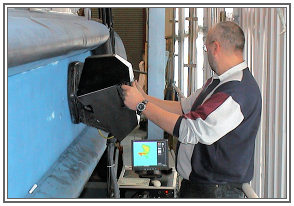
One example is laser shearography, an optical technique used to detect surface deformation and identify potential defects in materials and structures. It can be useful in applications where maintaining the integrity of the item being inspected is essential.
As industrial systems become more sophisticated, the importance of reliable optical equipment, accurate measurements and appropriate laser safety measures continues to grow.
Lasers are also increasingly integrated into automated production environments, where their performance depends on the quality of the optical system, the control equipment and the procedures used to operate them.
The Importance of Laser Safety
As laser technology has become more powerful and widely used, laser safety has become an essential consideration for industrial organisations.
Laser hazards vary according to the laser’s wavelength, power, operating mode and application. Direct exposure to certain laser beams can cause serious eye injuries or skin damage, while reflections may present additional risks in some environments.
Appropriate protective measures depend on a thorough assessment of the specific equipment and working conditions. These measures may include suitable protective eyewear, controlled access, beam enclosures, warning systems and appropriate staff training.
Optical components and protective equipment must also be selected for the intended wavelength and operating conditions. Not all protective products are suitable for every laser application.
Understanding these requirements helps organisations use laser technology effectively while protecting employees, equipment and working environments.
The Future of Industrial Laser Technology
The development of industrial lasers is continuing, with ongoing advances in beam control, automation, optical sensing and data processing.
Manufacturers are exploring increasingly precise laser processes, while engineers are developing new ways to use optical techniques for inspection, monitoring and quality assurance.
As production systems become more automated and component tolerances become increasingly demanding, the ability to measure, process and inspect materials accurately will remain important.
Laser technology is well positioned to support these requirements, provided that systems are designed, integrated and operated appropriately for their intended applications.
Conclusion
From the first working laser in 1960 to today’s advanced fibre lasers and optical inspection systems, the history of industrial lasers is one of continual innovation.
What began as a scientific breakthrough has become a technology that supports precision manufacturing, engineering measurement, industrial inspection and workplace safety across numerous sectors.
Understanding this history helps explain why lasers are now such an important part of modern industry — and why continued developments in optical engineering will remain central to their future.
At Laser Optical Engineering Ltd, we recognise the importance of precision optics and reliable laser technology in demanding industrial environments. Whether supporting optical inspection, measurement or laser safety requirements, selecting the right equipment for the application is essential to achieving dependable results.
To learn more about our optical engineering capabilities, laser safety products and industrial solutions, explore the Laser Optical Engineering website.