Non-destructive testing (NDT) plays a critical role in modern engineering, allowing industries to evaluate the integrity of materials and components without causing damage. One of the most advanced optical NDT methods available today is laser shearography, a powerful technique that delivers fast, full-field inspection of complex structures.
At Laser Optical Engineering, shearography is used to detect hidden defects in composites, bonded structures, and advanced materials with exceptional accuracy and efficiency.
What Is Laser Shearography?
Laser shearography is an interferometric inspection method that uses coherent laser light to measure how a surface deforms under stress. Instead of looking directly for cracks or voids, it identifies microscopic deformation differences that occur when a material is loaded.
A typical inspection involves:
- Illuminating the component with a laser
- Capturing a reference image of the surface
- Applying a small controlled stress (such as heat, vacuum, or mechanical load)
- Capturing a second image under load
- Comparing both images to reveal abnormal strain patterns
Defects such as delaminations, disbonds, impact damage, and voids cause localized changes in stiffness, which appear clearly in the shearography image as fringe pattern disturbances.
How Laser Shearography Works in Practice
Shearography systems measure the gradient of surface displacement rather than just surface movement. When a material is intact, it deforms uniformly under stress. However, if there is a subsurface flaw, that region responds differently.
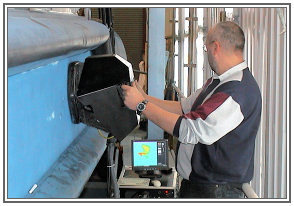
This difference in behaviour is captured in real time, producing a visual map of strain anomalies. Because the system captures a full area at once, it is highly efficient for inspecting large or complex surfaces such as:
- Aircraft composite panels
- Wind turbine blades
- Automotive bonded structures
- Rubber components and tyres
- Marine and aerospace sandwich panels
Benefits of Laser Shearography in NDT
Laser shearography offers a range of advantages over traditional inspection methods such as ultrasonic testing or dye penetrant inspection.
1. Full-field inspection
Unlike point-by-point methods, shearography inspects large areas in a single capture, significantly reducing inspection time.
2. Non-contact and non-invasive
No physical contact or coupling media is required, meaning delicate or sensitive surfaces remain completely undisturbed.
3. Extremely fast results
Defects are revealed in real time, allowing immediate decision-making during inspection.
4. High sensitivity to subsurface defects
Shearography is particularly effective at identifying hidden flaws such as:
- Delaminations
- Disbonds in adhesive joints
- Core damage in sandwich structures
- Impact damage not visible on the surface
5. Suitable for industrial environments
Modern systems are robust and tolerant of vibration, making them suitable for both laboratory and field use.
6. Improved quality assurance
By revealing defects early in production or maintenance, shearography helps reduce failures, rework, and costly downtime.
Why Industries Use Laser Shearography
Industries that rely on high-performance composite materials benefit significantly from shearography because it provides:
- Rapid inspection of large structures
- Reduced maintenance costs
- Improved safety and reliability
- Non-destructive evaluation of critical components
- Better lifecycle monitoring of assets
It is widely used in aerospace, wind energy, automotive manufacturing, and advanced materials engineering.
The Value of Laser Optical Engineering Solutions
Laser Optical Engineering develops advanced shearography systems designed for precision, reliability, and ease of use. These systems help engineers and inspectors identify hidden structural issues quickly and accurately, supporting safer and more efficient manufacturing and maintenance processes.
Conclusion
Laser shearography is one of the most effective modern NDT techniques for inspecting composite and bonded structures. By visualising strain anomalies rather than direct damage, it provides a powerful way to detect hidden defects before they become critical failures.
As industries continue to adopt advanced materials, shearography will remain an essential tool for ensuring structural integrity, safety, and performance.